Daily arXiv digest
Fresh from arXiv
Every day a bot picks a handful of new robotics and AI papers and writes a plain-language summary of each, in English and Japanese. These are the latest.
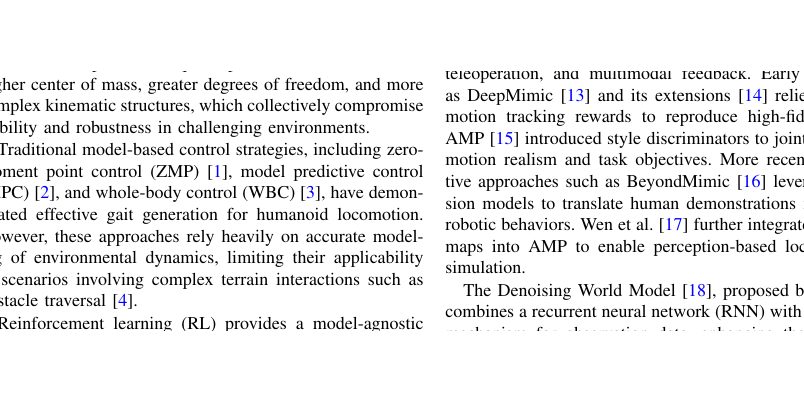 DAMP: Humanoid Locomotion via Denoised Belief Learning and Adversarial Motion PriorsThis paper presents DAMP, a reinforcement learning framework for robust and naturalistic humanoid locomotion over challenging terrains without exteroceptive perception. By leveraging RNNs to infer privileged latent states and combining them with adversarial motion priors, it achieves stable and goal-directed blind traversal across complex environments.
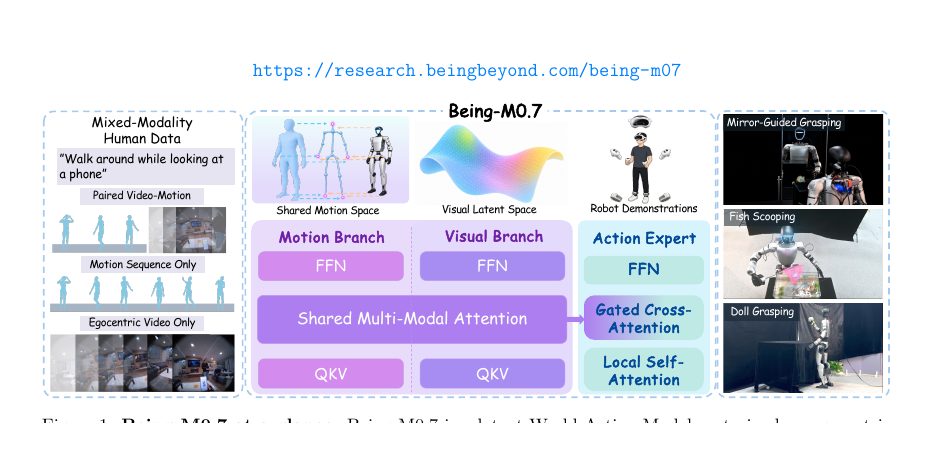 Being-M0.7: A Latent World-Action Model for Humanoid RobotsBeing-M0.7 is a latent world-action model designed for humanoid loco-manipulation. By pre-training on over 10,000 hours of human video and motion data and transferring learned visual-motion priors via mid- and post-training, it enables coordinated whole-body humanoid control across diverse manipulation tasks.
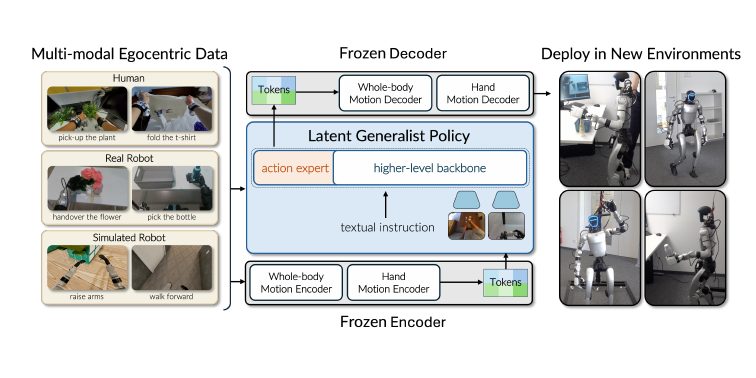 VioLA: Learning Generalist Humanoid Control Policies from Human DataVioLA introduces a generalist humanoid policy learned from large-scale human demonstrations. Instead of predicting low-level joint actions directly, it predicts whole-body target trajectories tracked by lower-level controllers, enabling out-of-the-box instruction following without task-specific teleoperated demonstrations.
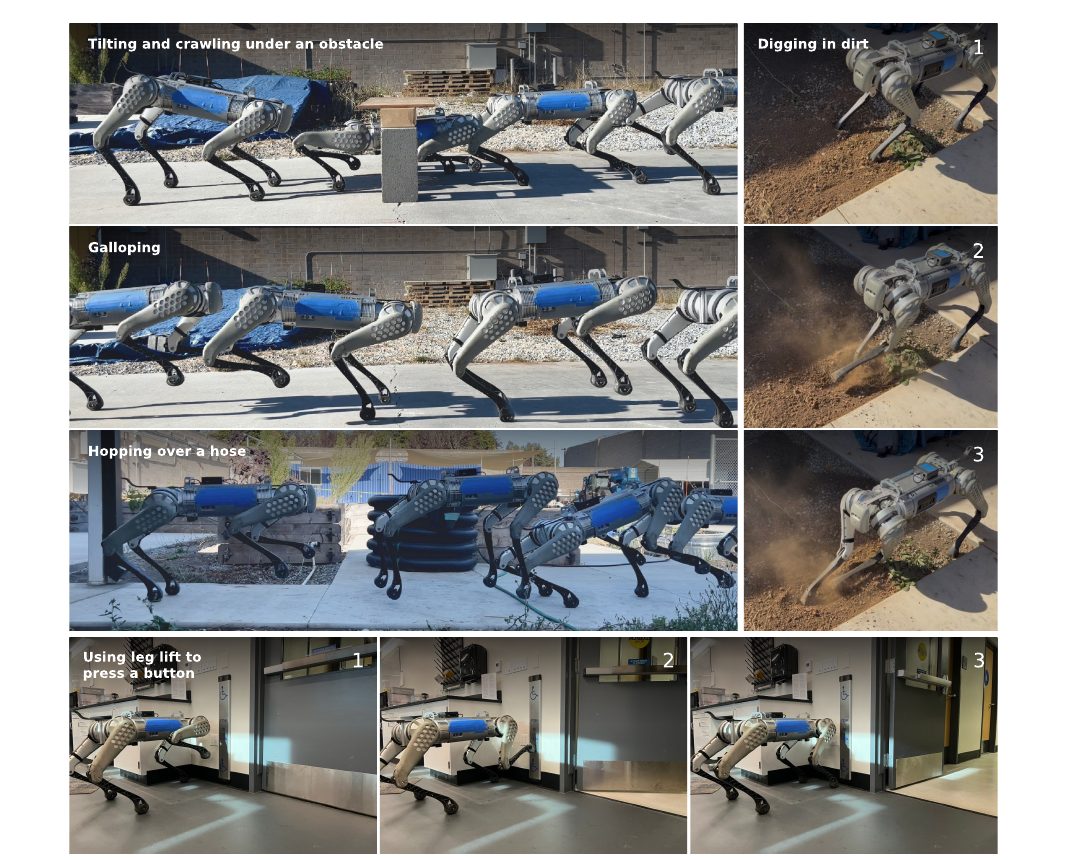 Teaching a Robot Dog New Tricks: Diverse Quadruped Skills via Combined Reinforcement and Imitation Learning with Adversarial Task SelectionThis paper presents a three-stage framework combining RL and imitation learning with adversarial task selection to train a single quadruped policy capable of diverse skills like walking, digging, and hopping. It mitigates multi-task gradient conflict by distilling multiple teacher policies into a unified student policy.
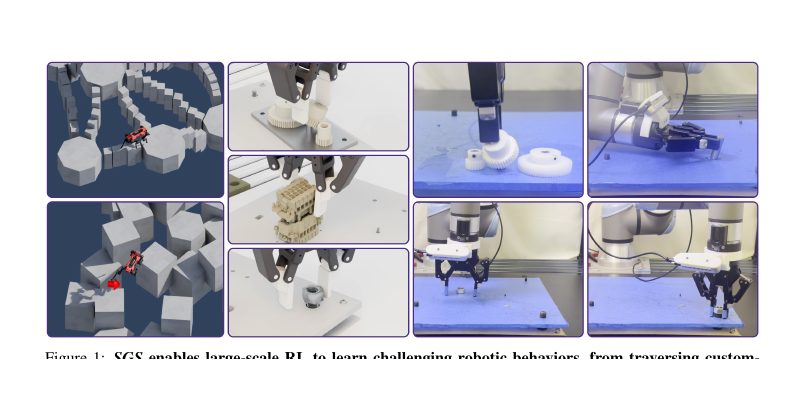 A Balanced Data Diet: Addressing the Exploration Bottleneck in Mega-Scale RL for Robot ControlThis work tackles the exploration bottleneck in mega-scale parallel RL for agile locomotion and dexterous manipulation. By showing that uniform reset distributions hinder training efficiency, it proposes an adaptive reset sampling strategy that significantly improves learning progress and policy performance.
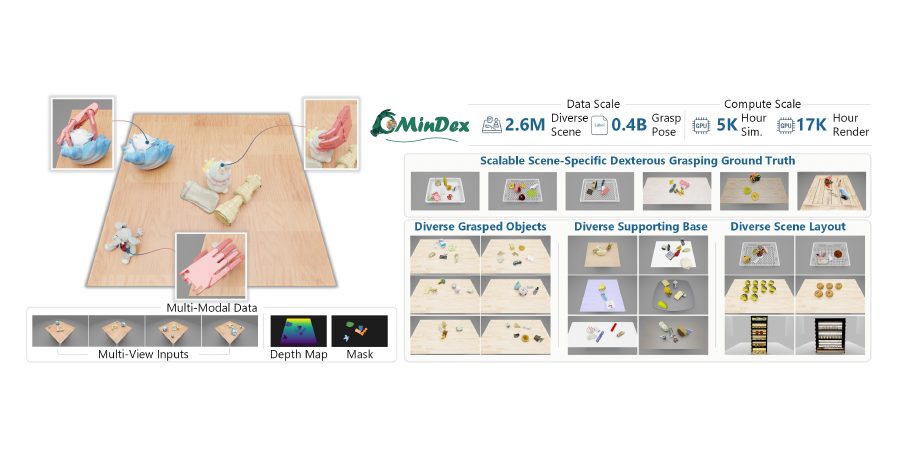 OmniDex: Scaling Dexterous Hand Grasping to Diverse Cluttered ScenesOmniDex introduces a massive simulation dataset and benchmark for dexterous grasping in cluttered environments. Using a scalable seed-and-filter strategy, it generates over 2.6 million scenes and 0.4 billion grasp ground truths, providing rich training data to overcome real-world data scarcity.