What I’m working on now, and the research threads behind all 34 of my papers, grouped into 10 projects.
One model for any robot body, from tabletop arms to full humanoids.
I’m part of the Gemini Robotics team at Google DeepMind, building vision-language-action models that let robots understand a task, reason about it and act. I focus on the model’s intelligent whole-body control capability.
Gemini Robotics 2, announced in July 2026, controls whole humanoid bodies from feet to fingertips. It balances the robot’s center of gravity so it can step, squat and bend through cluttered spaces instead of reaching from a fixed stance, and the same model also drives two-armed platforms and dexterous hands.

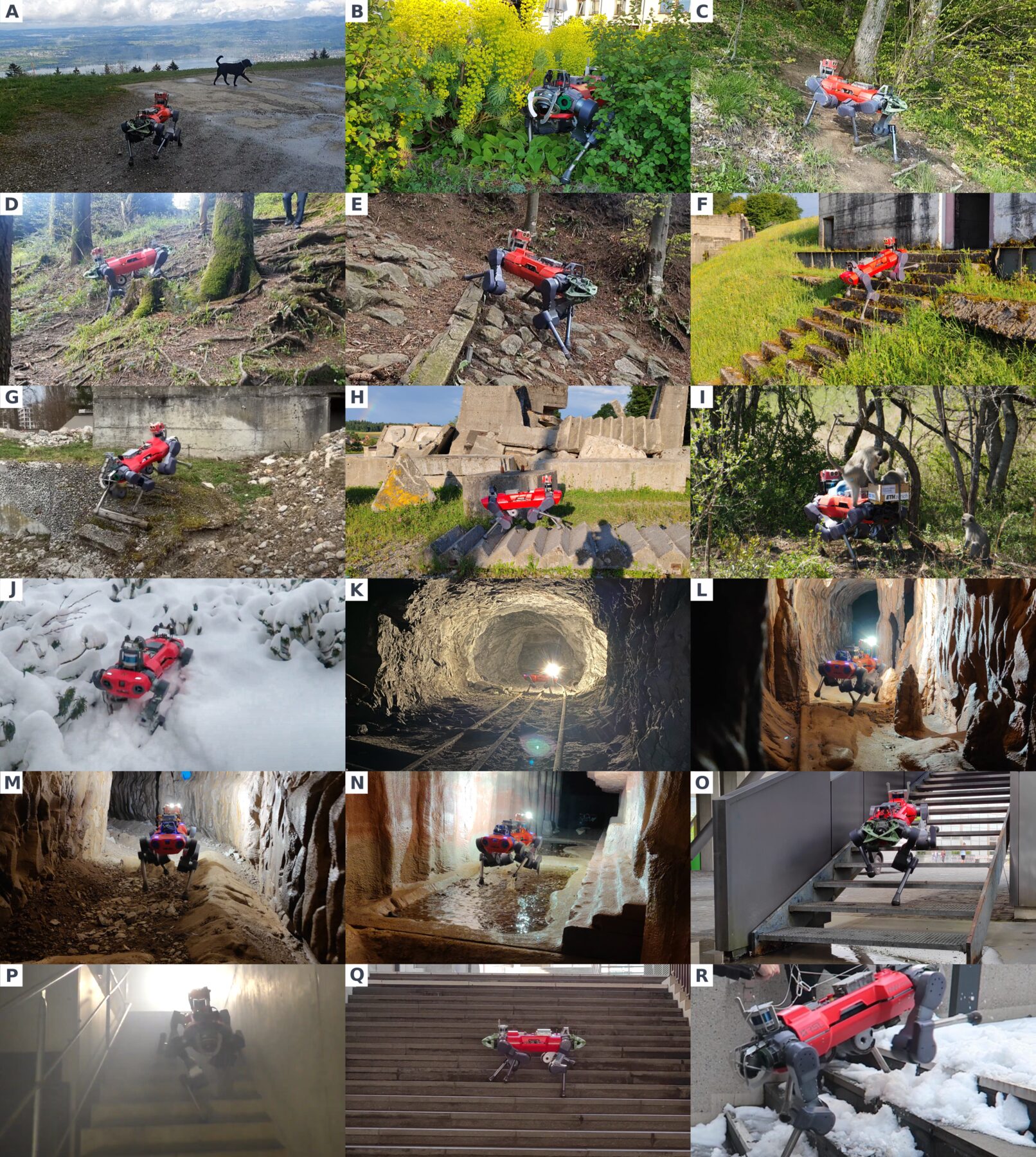
Reinforcement learning that lets legged robots see the ground and still trust their legs.
Using reinforcement learning to make quadrupedal robots walk: policies are trained in simulation on procedurally generated terrains and deployed directly on the ANYmal robot.
The core idea is to combine what the robot sees with what it feels, so it stays fast and stable when perception is wrong: in snow, tall grass, glare or darkness. This line of work took ANYmal up a mountain trail, into collapsed spaces and across Mars-like terrain.
Finding where learned controllers fail, and teaching them to be careful.
A walking policy trained with reinforcement learning can look robust in every demo and still hide failure cases. This line of work attacks policies on purpose to find those weak spots, gives them a sense of their own uncertainty and risk, and uses human preferences to shape how they behave.
It also covers robots that share our homes, like making a small home quadruped walk quietly enough to live with.

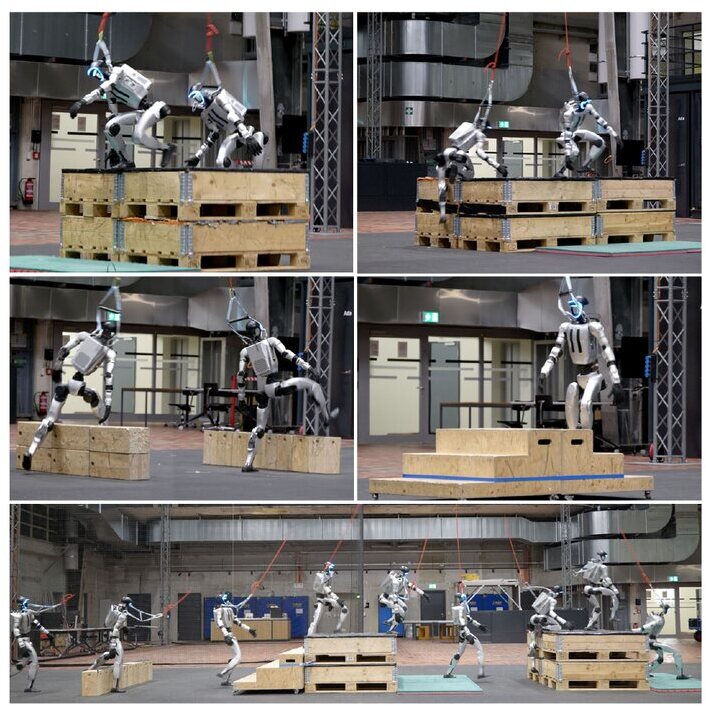
Learning from recorded motion so robots move naturally, then adapting it to rough terrain.
Instead of shaping every gait with hand-written rewards, these projects start from real motion data: animal motions for a quadruped and retargeted human motions for a humanoid.
A second layer then adapts those natural movements to what the robot sees, so it can climb boxes, hurdles and stairs while still moving like the motion it learned from.

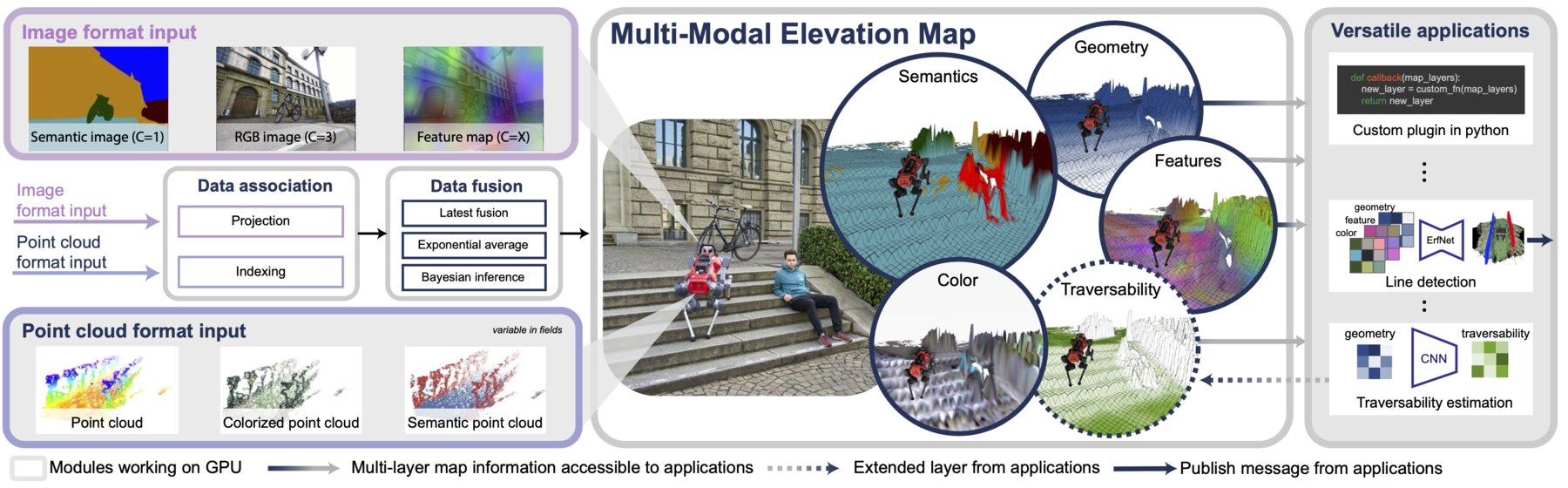
elevation_mapping_cupy: fast, GPU-based terrain maps for legged robots, and planning on top of them.
Developing open-source elevation mapping software, elevation_mapping_cupy. It turns depth and LiDAR data into a robot-centric height map on the GPU, with traversability, smoothing, inpainting and plane segmentation built in, and was later extended to fuse color and semantics.
On top of the map: learning to fill in areas hidden behind rocks, and planning paths with motion costs learned from how the robot actually moves.
Legs that also handle things: opening doors, balancing an arm, catching a ball.
A legged robot becomes far more useful when it can also interact with the world. These projects combine learned locomotion with an arm, or use the legs themselves as manipulators.
They range from opening and walking through doors and keeping balance while an arm pushes on the body, to turning a large ball with the legs and catching a thrown ball in a net using an event camera.

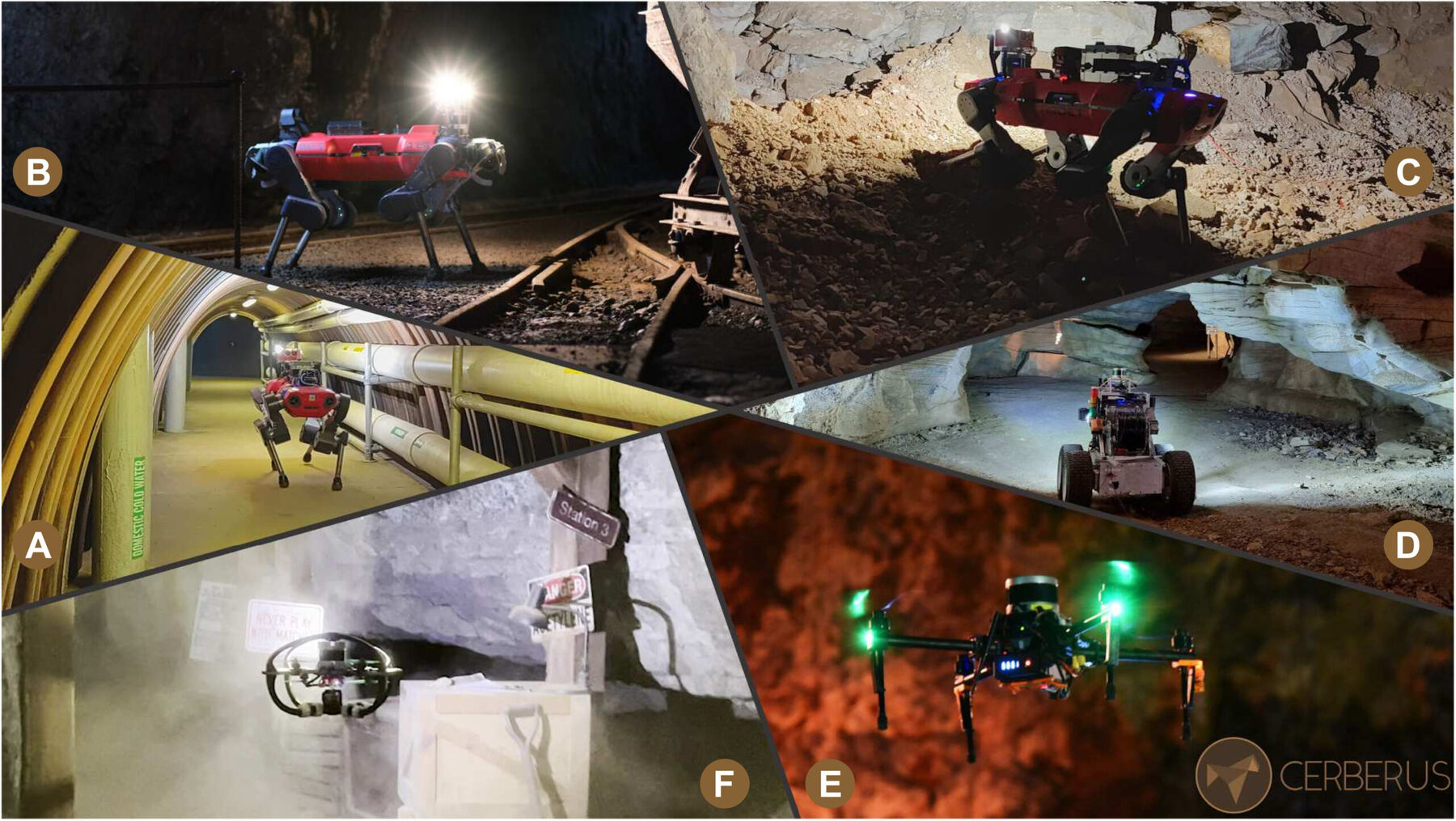
First place and the $2,000,000 prize in the 2021 Final.
I competed in the DARPA Subterranean Challenge as a member of Team CERBERUS, and we won first prize, a $2,000,000 award, in the Final Event.
Legged and flying robots had to explore, map and search an unknown underground course of tunnels, caves and a subway station, with no GPS and almost no communication back to the operators.
Taking legged robots to volcanoes, planetary analog sites and city streets.
Robots that walk well are only the start; the goal is to do useful work in challenging places. These deployments put legged robots to work as scientific instruments and autonomous explorers.
A team of robots explored Moon- and Mars-like terrain, ANYmal measured volcanic gas on Mount Etna, and a wheeled-legged robot completed long autonomous missions through a city.
Where it started: aerial robots, lunar rovers and multi-robot decision-making.
Before legged robots, I worked on drones and rovers: a drone that localizes itself by sticking AR markers onto its surroundings, a drone that anchors a tether so a rover can winch itself up a cliff, and decision-making for teams of drones searching for targets.
Along the way: a lunar-surface simulator for a microrover at ispace, and a dual-arm store-stocking robot at Hitachi.
Hiding a secret inside a language model, and trying to steal everyone else’s.
For the IEEE SaTML 2024 capture-the-flag competition, teams built defenses that kept a secret hidden in an LLM’s system prompt, then attacked each other’s defenses. Our team, RSLLM, took 2nd place, and the competition’s dataset and lessons were published at NeurIPS 2024.